Helping organisations build the conditions for sustainable performance
When Passion Funds Your Systemic Exhaustion
The Autonomy Paradox

A few days ago, I discovered something uncomfortable.
The framework I built to detect Hidden Strain flagged it in me.
- Not because I lacked purpose.
- Not because I lacked autonomy.
- Precisely because I had both.
The results were a stark reminder that understanding a problem does not make you immune to it. In fact, sometimes the very conditions that drive performance make it harder to recognise when sustainability is starting to erode.
The data revealed a strong alignment signal, but underneath that apparent coherence sat a widening gap between two layers of my operating environment:
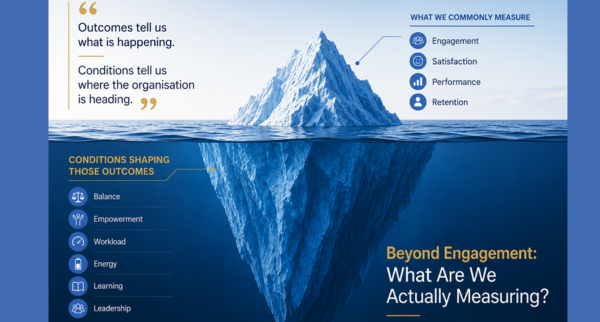
- The Strategic Engine was operating well. Learning and Leadership conditions were strong, while Empowerment remained stable. Conceptually, strategically, and motivationally, the system was functioning as intended. I had clarity, purpose, and complete room to act.
- The Operational Layer was showing a different reality. Workload and Energy were under pressure. Balance was developing but uneven.
- The conditions required to sustain execution were lagging behind the commitment driving it. The assessment flagged this as a Hidden Strain pattern.
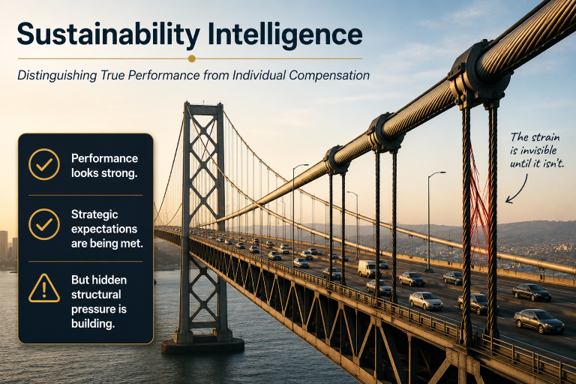
The structural reality was simple: My strategic clarity and deep commitment to the mission had become a personal shock absorber for an unsustainable operating rhythm.
From the outside, everything looked functional. Progress was being made. Decisions were being taken. Work was moving forward.
But the system was relying heavily on personal reserves to compensate for conditions that were no longer fully sustainable.
The Autonomy Trap in Growth Environments
This is not a motivation problem. It is not a mindset problem. And it is certainly not a question of commitment.
In fact, commitment is often part of the problem.
Many founders, executives, and leaders of growing organisations possess something most employees actively seek: autonomy. They have the authority to decide, influence priorities, shape direction, and act quickly.
Yet autonomy without sufficient balance can become a trap.
When leaders care deeply about what they are building, they absorb pressure willingly. They work longer, compensate for gaps, solve bottlenecks personally, and push through fatigue because the mission matters. The very freedom that enables performance can also make it easier to ignore the conditions required to sustain it.
- What appears to be resilience may simply be overcompensation.
- What appears to be agility may simply be one person carrying too much of the system.
Research increasingly points toward this distinction. Harvard Business Review has argued that burnout is fundamentally a workplace and work-design issue rather than an individual weakness (Moss, 2019). Similarly, Maslach and Leiter's work suggests that exhaustion emerges when work systems consistently demand more than the surrounding conditions can sustainably support (Maslach & Leiter, 2016).
In other words, highly committed people do not redline because they care too little.
They redline because they care enough to compensate for structural problems for far longer than they should.
When Performance Hides Risk
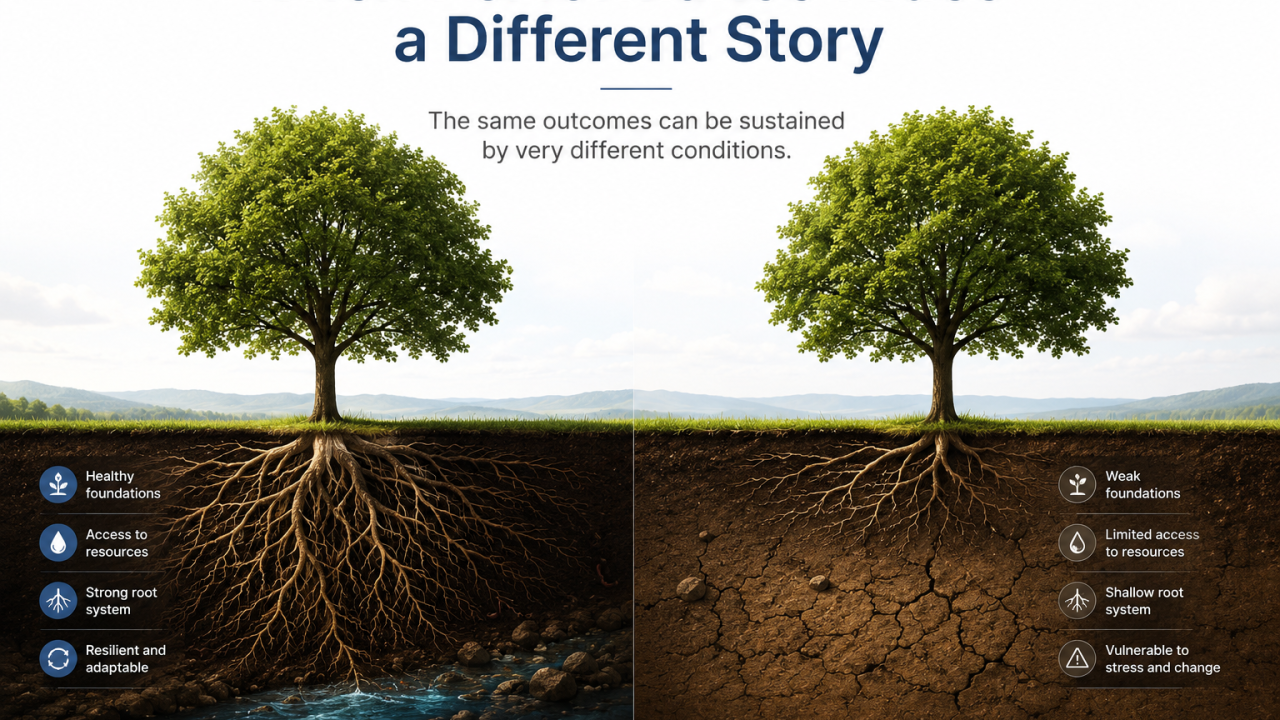
One of the critical challenges for leadership is that strong performance is a poor indicator of sustainability.
Most traditional metrics focus entirely on outputs: Revenue. Growth. Delivery. Execution. Customer outcomes.
All of these matter. But they can remain healthy long after the conditions supporting them have started deteriorating. McKinsey's research on organisational health demonstrates that long-term performance depends not only on results, but on the underlying conditions that make those results sustainable over time (Keller & Price, 2011).
The difficulty is that deteriorating conditions rarely appear immediately in performance metrics.
People compensate. Teams absorb pressure. Managers work around obstacles. Leaders carry an additional load. The organisation continues performing, until it doesn't.
By the time traditional indicators finally reveal a problem, the underlying strain has often been accumulating for months or years.
Shifting from Grit to Capacity Design
In many organisations, endurance is still treated as a competitive advantage. But endurance is a finite resource.
Personal resilience matters. Adaptability matters. Commitment matters. But none of them can replace thoughtful capacity design.
Sustainable organisations do not depend on exceptional people to continuously compensate for flawed operating conditions. They build environments where performance and organisational sustainability reinforce one another.
That requires leaders to pay attention not only to outcomes, but to the ecosystem producing those outcomes. It means asking different questions:
- Where are people compensating for structural friction?
- Where is commitment masking exhaustion?
- Where is performance being sustained through sheer effort rather than supported through design?
- What happens if the people currently carrying the system stop carrying it?
Because when passion becomes the primary mechanism holding an operating system together, the issue is no longer resilience.
It is a risk. And risk, left unexamined, eventually becomes a direct hit to performance.
A question for scale-up leaders and executives:
Where is your team's visible performance currently dependent on extra individual effort rather than on supportive organisational conditions?
And what happens to your growth trajectory if that effort suddenly disappears?
Conversations with founders and growth-stage leaders in the Galway innovation ecosystem continue to reinforce how common this pattern can become as organisations scale.
References
- Keller, S., & Price, C. (2011). Beyond Performance: How Great Organizations Build Ultimate Competitive Advantage. Boston, MA: Harvard Business Review Press.
- Maslach, C., & Leiter, M. P. (2016). Burnout. In G. Fink (Ed.), Stress: Concepts, Cognition, Emotion, and Behavior (pp. 351–357). Academic Press.
- Moss, J. (2019). Burnout Is About Your Workplace, Not Your People. Harvard Business Review. Retrieved from https://hbr.org/2019/12/burnout-is-about-your-workplace-not-your-people