


Helping organisations build the conditions for sustainable performance
Building the Evidence
Every framework begins as an idea.
Its value is determined by how rigorously it is challenged, refined and applied.
Organisational Sustainability Intelligence is not presented as a finished destination.
It is an evolving body of work, developed through operational experience, structured reflection, pilot organisations and continuous learning.
The objective has never been to defend a theory.
It is to build a framework that helps organisations better understand the conditions shaping sustainable performance.
Organisational Sustainability Intelligence (OSI)
The Organisational Sustainability Intelligence (OSI) Working Paper Series documents the ongoing development of a conditions-based interpretive approach to sustainable organisational performance.
The papers are published as working papers to encourage discussion, critical review and continuous refinement. They should be read as evolving contributions rather than definitive conclusions.
What Is Organisational Sustainability Intelligence?
Version 1.5 | July 2026
Towards a Conditions-Based Understanding of Sustainable Organisational Performance
Abstract: Organisations have become increasingly sophisticated at measuring performance. Yet measuring organisational outcomes and understanding how those outcomes are sustained are not necessarily the same endeavour. Outcomes such as engagement, wellbeing, burnout and performance provide valuable information, but they often describe organisational reality without fully explaining the conditions through which that reality is created. This first working paper introduces Organisational Sustainability Intelligence (OSI) as an emerging interpretive approach to understanding sustainable organisational performance. The proposition explored here is not that organisational conditions interact, a relationship already recognised across systems thinking, the Job Demands–Resources model and related organisational health frameworks, but that this interaction can be examined through a structured, repeatable interpretive methodology capable of supporting richer organisational conversation. In this respect, OSI is intended to support a discussion about organisational conditions rather than to produce a rating: the interpretive layer described in this paper is designed to prompt reflection, not to rank or benchmark individuals or organisations against one another. The paper traces the origins of this perspective from recurring observations in leadership practice through the development of the BE-WELL™ Framework and the questions that ultimately led to a broader programme of investigation. It introduces the conceptual foundations of OSI, presents the OSI Interpretive Cycle, and outlines the rationale for a conditions-based approach to organisational interpretation. This paper is intended as the first publication in an evolving working paper series. Its purpose is not to present definitive conclusions, but to establish the research question, provide a conceptual foundation for subsequent papers, and invite continued discussion, critical reflection and empirical investigation.
Keywords: Organisational Sustainability Intelligence, organisational sustainability, sustainable performance, organisational conditions, systems thinking, leadership, organisational diagnostics, interpretive framework.
Defining Organisational Conditions
Towards a Conditions-Based Architecture for Sustainable Organisational Performance
Planned Release: 2026
Status: In Development
Abstract: This paper explores the conceptual foundations of the BE-WELL™ Framework by examining the six organisational conditions that underpin Organisational Sustainability Intelligence (OSI). It considers why these conditions were selected, how they relate to existing organisational research, and why they are organised into the Foundation, Operational and Capability layers. The paper also examines the distinction between organisational conditions and organisational outcomes, providing the conceptual architecture that underpins the OSI framework.
Keywords: TBD
From Measurement to Interpretation
How Organisational Observations Become Leadership Insight
Planned Release: 2026
Status: In Development
Abstract: Traditional organisational assessments often focus on measurement and reporting. This paper explores how OSI moves beyond isolated scores by interpreting interactions between organisational conditions, indicators and emerging patterns. It introduces the principles of interpretive consistency, explains why similar profiles can generate different organisational narratives, and outlines the methodology that transforms structured observations into meaningful leadership conversations.
Early Evidence from the BE-WELL™ Pilot
Observations from the Development of Organisational Sustainability Intelligence
Planned Release: 2027
Status: In Development
Abstract: This paper presents early observations emerging from the BE-WELL™ individual and organisational pilot programmes. Rather than seeking to prove the framework, it explores how repeated patterns, participant feedback and organisational case studies have informed the ongoing refinement of OSI. The paper discusses emerging evidence, limitations, and the role of iterative learning in developing an evidence-informed interpretive framework.
From Experience to Evidence
The development of BE-WELL™ has been an iterative journey rather than a single moment of creation.
Each stage has contributed to strengthening the framework, from operational experience and structured reflection to pilot organisations, published thinking and ongoing refinement.
Together, these milestones demonstrate a commitment to building understanding through evidence rather than assumption.
Twenty years of practice
Before developing BE-WELL™, I spent more than two decades leading international operations, building high-performing teams and supporting organisations through growth, transformation and change. Working across different industries, cultures and leadership environments revealed a recurring pattern: organisations often achieved strong results while silently placing increasing pressure on the people and systems sustaining them.
Those experiences shaped an enduring question that traditional performance metrics rarely answered:
What organisational conditions make sustainable performance possible, and how can we recognise when those conditions are beginning to weaken?
BE-WELL™ was born from that question. The framework did not begin with a theory looking for evidence. It began with years of observing organisational reality and searching for a better way to interpret it.
Building the Framework
Transforming those observations into a practical framework required considerably more than identifying six organisational dimensions.
Over 2,500 hours were invested in reading, writing, modelling, challenging assumptions and refining every aspect of the framework before the first organisational pilot began. Concepts were repeatedly tested for clarity, language was simplified, visual models were redesigned, and reporting evolved through continuous iteration.
The objective was never to produce another organisational survey.
It was to create a conditions-based framework that helps organisations interpret the underlying factors shaping sustainable performance.
Versioning remains central to this philosophy. Every revision reflects a commitment to improving understanding rather than increasing complexity.
Learning through Individual Pilot Programme
The individual pilot programme marked the first opportunity to test the framework with people from different organisations, sectors and leadership roles.
Participants were invited not only to complete the assessment, but also to challenge the clarity, relevance and usefulness of the reports and interpretations. Their feedback influenced question wording, report structure, visual presentation and the language used throughout the framework.
Perhaps the most valuable insight was that participants consistently recognised experiences the framework described but had struggled to articulate themselves.
These conversations reinforced an important principle:
The assessment is not the outcome. It is the beginning of a more informed conversation.
Testing in Organisations
The organisational pilot represents the next stage in the framework's evolution.
Rather than focusing on individual perspectives alone, the assessment examines patterns emerging across teams, departments and leadership levels. The objective is to understand how organisational conditions interact and where hidden structural strain may be developing beneath stable performance.
This stage also tests whether the framework can consistently support meaningful dialogue between leadership teams and employees by creating a shared understanding of organisational reality.
The emphasis is not on benchmarking organisations against one another.
It is on helping each organisation better understand its own conditions and strengthen its capacity for sustainable performance.
Publishing the White Paper
Documenting the framework is an essential part of developing it.
The white paper captures the thinking behind BE-WELL™, explains its underlying philosophy and describes how a conditions-based approach differs from traditional organisational diagnostics. It also documents the early development journey, emerging insights and the principles guiding future refinement.
Writing serves another purpose.
It creates an opportunity to challenge assumptions, improve conceptual clarity and expose the framework to constructive scrutiny.
The white paper should therefore be viewed as another milestone in the evolution of the framework rather than its final statement.
Continuing the Research
The Journey Continues
Organisational Sustainability Intelligence is intended to remain a living body of work.
Future development will be informed by additional organisational pilots, cross-sector learning, larger datasets, academic collaboration and continued dialogue with leaders and organisations applying the framework in practice.
The ambition is not to create a perfect model.
It is to continually improve the framework's ability to help organisations understand the conditions that shape sustainable performance and to provide increasingly meaningful insights over time.
Every conversation, every assessment and every organisational pilot contributes to that journey.
The Framework Today
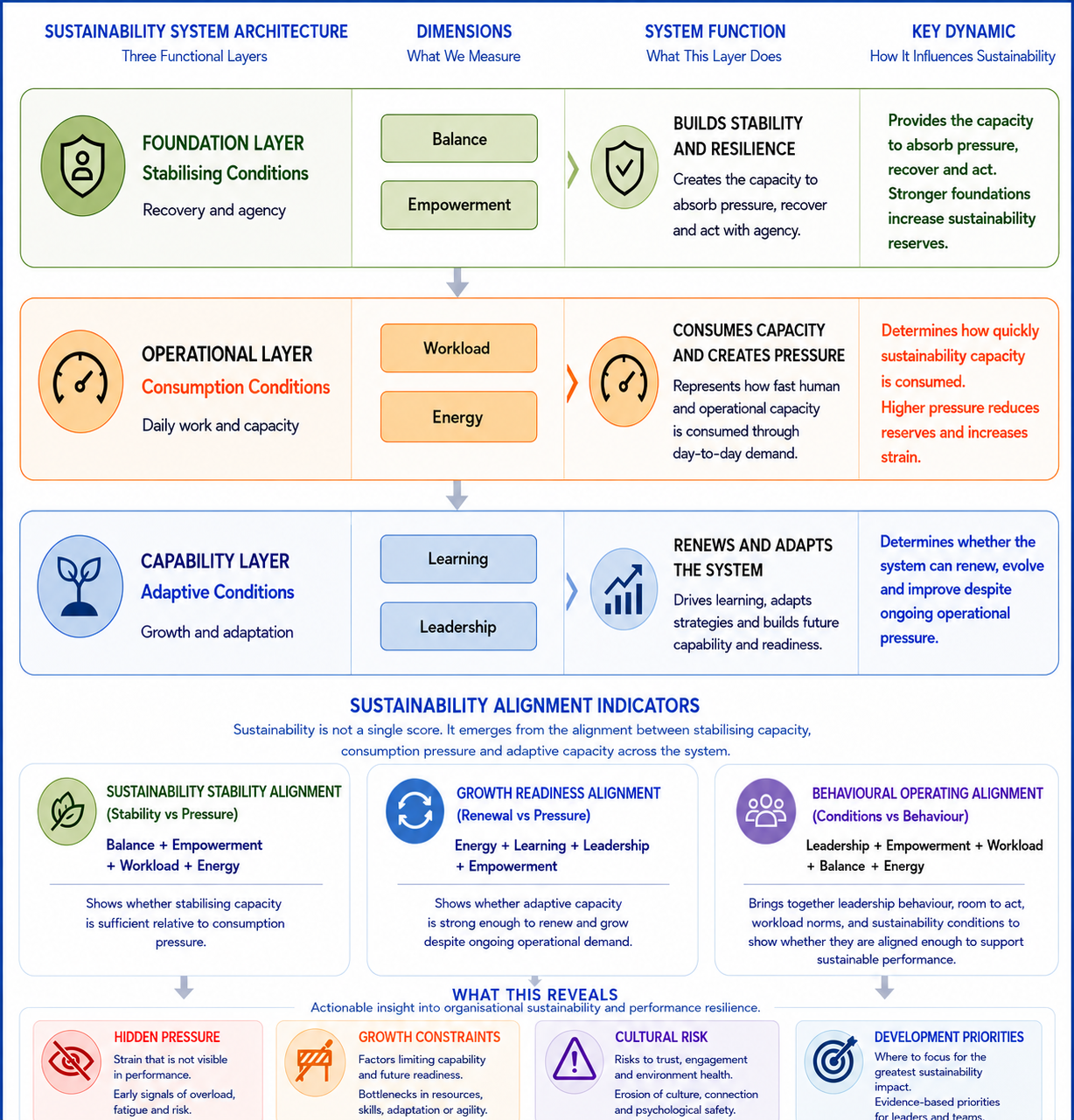
The journey described above has shaped a conditions-based framework for interpreting organisational sustainability.
The architecture below brings together the three functional layers, six organisational dimensions and sustainability alignment indicators that underpin BE-WELL™ Version 1.0.
Rather than representing a finished destination, it marks the current stage in an ongoing programme of learning, refinement and evidence building.
Evidence is not collected. It is built. one conversation, one organisation and one insight at a time.