Helping organisations build the conditions for sustainable performance
We Expect Exhaustion to Look Exhausted
Performance or Compensation?
Why some of the people most at risk are the people we worry about least
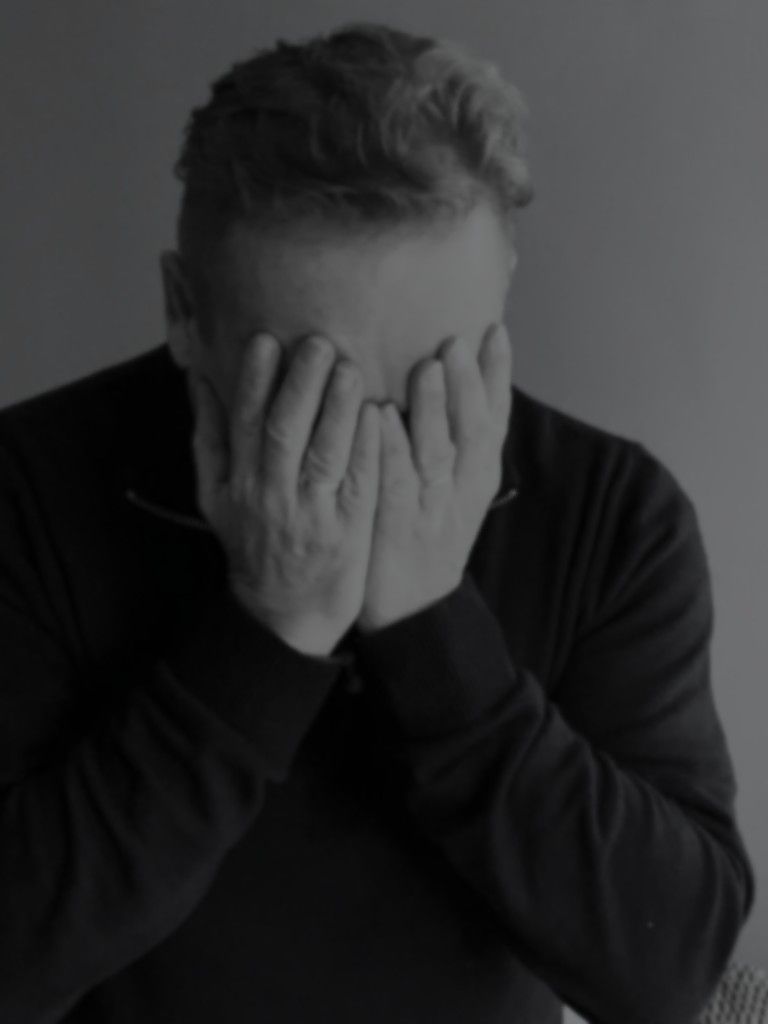
The colleague who eventually hit a wall of total exhaustion, was the last person I would have worried about.
- He was positive. Reliable. Capable.
- The person everyone trusted.
- The person who always found a way.
- The person who never seemed overwhelmed.
- He worked long hours, took responsibility seriously, and consistently delivered results.
Not long after I left the organisation, he took three months off medical leave. Looking back, I realise I was watching his performance. I wasn’t paying enough attention to what it was costing him.
We Expect Exhaustion To Look Exhausted
What makes this story uncomfortable is that I didn't see it coming either.
- I knew he worked hard.
- I knew people depended on him.
- I knew he cared deeply about the team and the work.
- What I also remember is that he was almost always positive.
He wasn't:
- The person complaining about the workload
- The person creating tension
- The person raising alarm bells
If anything, he was the opposite. He remained cheerful, constructive, and focused on finding solutions. Perhaps that is part of the problem.
Many organisations assume risk will announce itself.
We expect:
- Exhaustion to look exhausted
- Burnout to look disengaged
- Pressure to show up as visible frustration
But some people respond differently.
- They compensate
- They adapt
- They carry more
- They absorb pressures that the system itself is struggling to absorb
Looking back, I wonder whether his positivity made it easier for all of us, including me, to underestimate the cost of what he was carrying.
The Question I Can't Ignore
Years later, when I had the opportunity to coach him, I found myself returning to a question that has become increasingly important in my work.
Was his performance a sign of sustainability?
Or was it masking the cost of compensation?
The question that keeps coming back to me is whether performance was being generated by the system or compensated for by committed individuals.
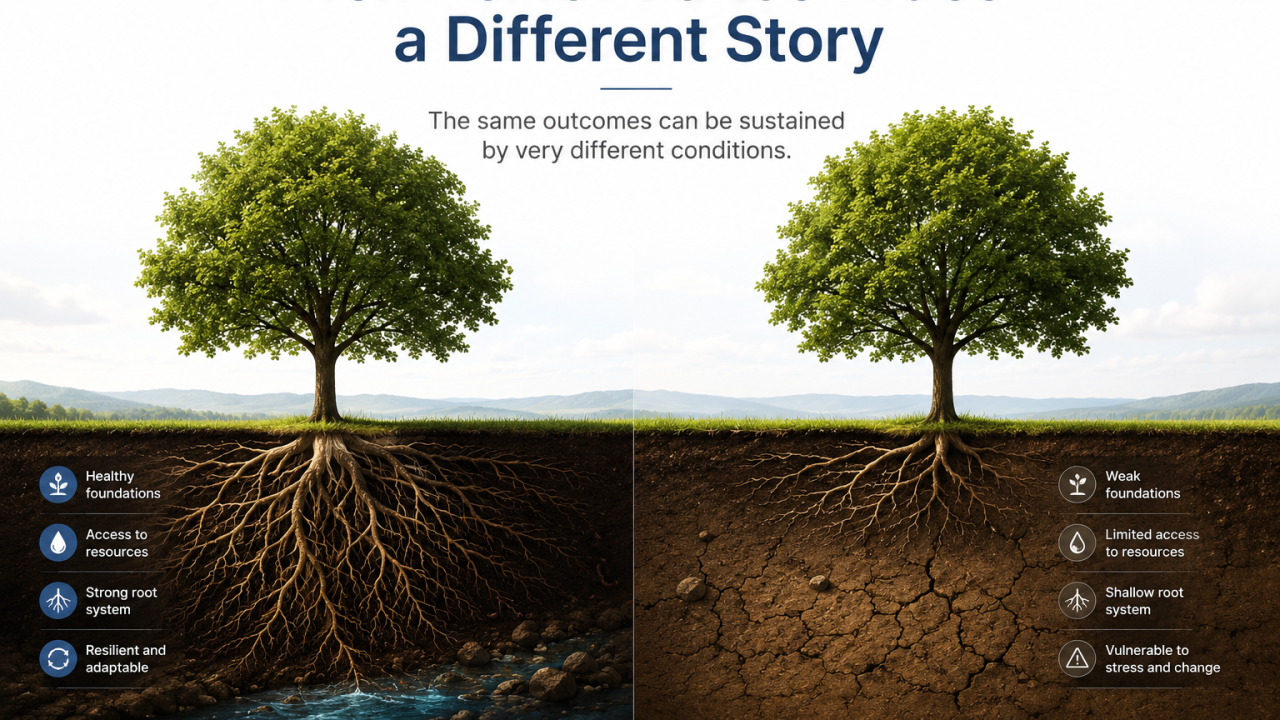
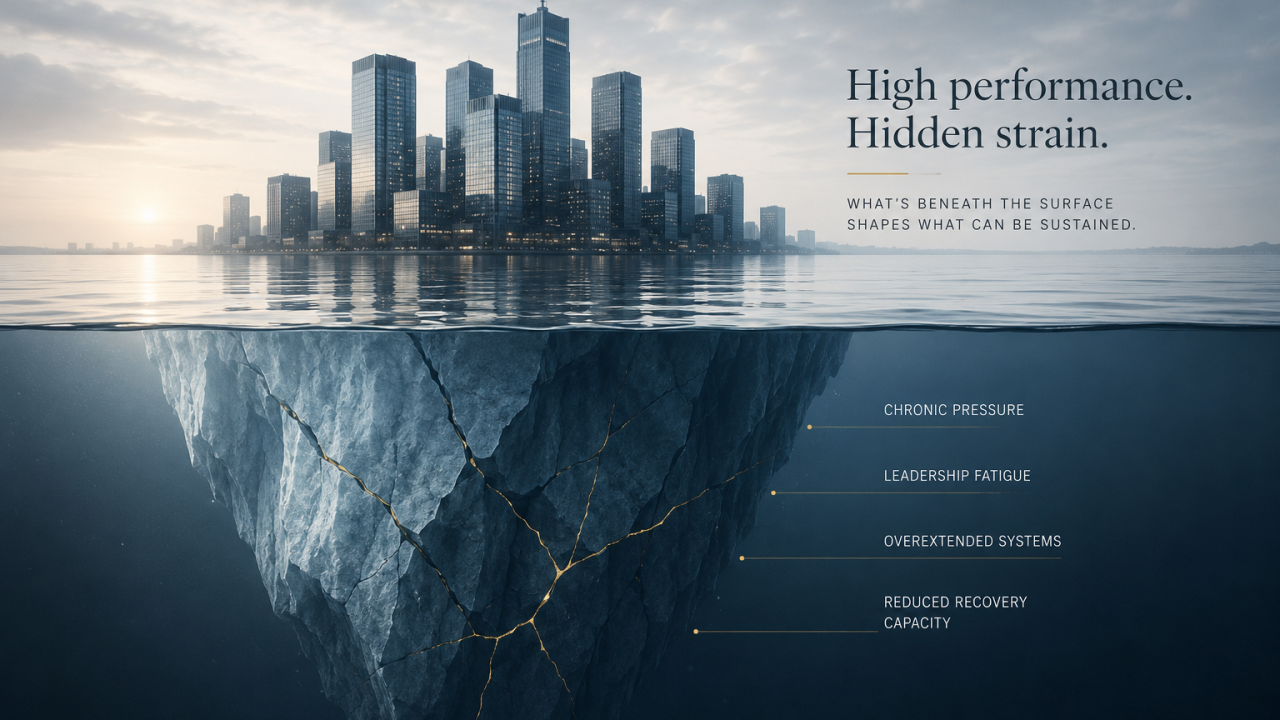
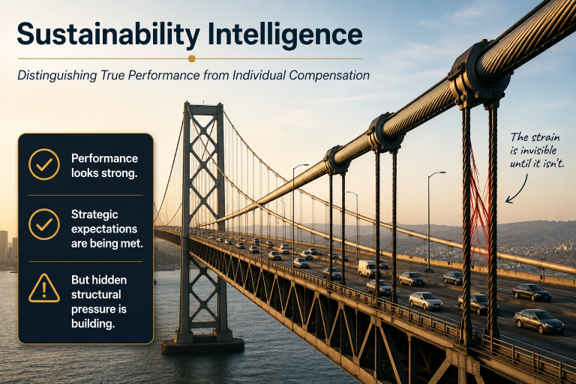
From the outside, both can look identical.
- Targets are achieved
- Customers are supported
- Projects are delivered
- The leader keeps going
- Everything appears to be working.
But what if strong performance is sometimes the very thing that hides unsustainable conditions?
A Reflection Closer To Home
Ironically, while reflecting on his story, I found myself looking at my own recent BE-WELL™ profile.
- The details were different. The question wasn't.
- Could strong commitment be masking conditions that were becoming increasingly difficult to sustain?
- The assessment highlighted something I had spent years observing in others.
- Understanding an operational problem does not make us immune to it.
In fact, some of the qualities we most admire in leaders, commitment, responsibility, adaptability, and resilience, can also make it harder to recognise when sustainability is starting to erode.
The Evidence Is Not New
What troubles me is that I don't think his story is unusual.
Over the years, I've seen similar patterns in managers, specialists, founders, executives, volunteers, and board members.
- The people who eventually hit the wall are rarely the people everybody worries about.
- They are often the people everybody relies upon.
- Looking back, I am not sure we were measuring the right things.
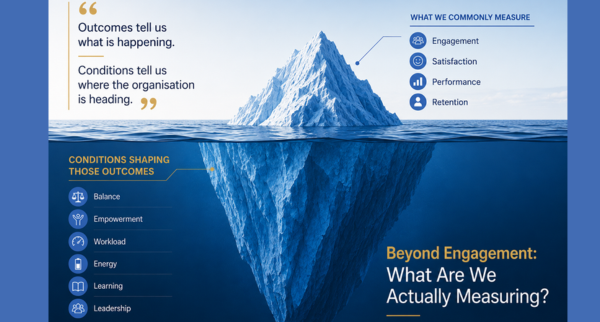
We measured:
- Performance
- Delivery
- Outcomes
What we weren't measuring was the cost of producing them.
Perhaps that is why so many organisations are surprised when a high performer suddenly hits a structural wall.
The signals were often there. We simply weren't looking in the right place.
Research has been pointing in this direction for years.
- Christina Maslach and Michael Leiter argued that burnout is less about individual weakness and more about the relationship between people and their working environment (Maslach & Leiter, 2016).
- Jennifer Moss later made a similar argument in Harvard Business Review, suggesting that burnout is fundamentally a workplace problem rather than a personal failure (Moss, 2019).
- McKinsey’s work on organizational health has consistently reinforced this reality. While Keller and Price originally established that long-term performance depends entirely on the operating conditions that make results sustainable (Keller & Price, 2011).
- More recent global research by Alex Camp, Arne Gast, Drew Goldstein, and Brooke Weddle demonstrates that structural health remains the leading indicator of value creation and systemic resilience (Camp et al., 2024).
The challenge is that committed people can mask deteriorating conditions for a very long time.
This distinction is critical. When we look through the lens of Sustainability Intelligence, our focus is entirely distinct from traditional corporate wellness or individual well-being initiatives.
- Well-being asks how the individual can better cope with stress; being well asks whether the organization's architecture is built to withstand it.
- As the modern McKinsey data implies, structural sustainability is not a human resource benefit, it is an execution capability.
When leaders confuse individual compensation for true performance, they aren't just mismanaging people; they are miscalculating the actual capacity of their operating system.
Effort Is Not Sustainability
One lesson I keep returning to is that effort is not the same thing as sustainability.
Most organisations can generate extraordinary effort for short periods.
The real test is whether performance continues when extraordinary effort is no longer required.
Sustainable systems do not depend on people repeatedly exceeding reasonable limits.
They create conditions where performance can continue without asking individuals to carry the system on their shoulders.
A Different Leadership Question
The people who eventually break are not always the people struggling visibly.
Often, they are the people everyone depends upon.
- The reliable ones.
- The capable ones.
- The people who stay positive.
- The people who quietly compensate for pressures that the system itself is failing to absorb.
Which leaves leaders with a different question:
- Is your performance being generated by supportive operating conditions?
- Or is it being maintained through the commitment and extra effort of individuals?
From the outside, both can look equally successful.
Both can produce results. Both can create the appearance of stability.
The difference only becomes visible when the people carrying the load can no longer carry it.
By then, the cost is usually far greater than the effort that would have been required to address the conditions earlier.
- Perhaps the future of leadership is not becoming better at driving performance.
- Perhaps it is becoming better at distinguishing performance from compensation.
Sustainable performance is not created when people continually carry more than they should.
It is created when the conditions supporting performance are strong enough that they no longer have to.
References
Camp, A., Gast, A., Goldstein, D., & Weddle, B. (2024). Organizational health is (still) the key to long-term performance. McKinsey & Company. The power of organizational health | McKinsey
Gallup. (2025). State of the Global Workplace 2025 Report. State of the Global Workplace 2026 | Employee Engagement Data & Trends - Gallup
Keller, S., & Price, C. (2011). Beyond Performance: How Great Organizations Build Ultimate Competitive Advantage. John Wiley & Sons.
Maslach, C., & Leiter, M. P. (2016). Burnout. In G. Fink (Ed.), Stress: Concepts, Cognition, Emotion, and Behavior. Burnout - ScienceDirect
Moss, J. (2019). Burnout Is About Your Workplace, Not Your People. Harvard Business Review. Burnout Is About Your Workplace, Not Your People