Helping organisations build the conditions for sustainable performance
Beyond Engagement: Are We Measuring the Right Things?
Conditions Shape Outcomes

The more organisations I speak with, the more I find myself returning to the same question:
Are we measuring what matters most, or simply measuring what is easiest to measure?
Most organisations today measure something.
· Engagement.
· Satisfaction.
· Retention.
· Culture.
· Employee experience.
· Leadership effectiveness.
The available tools have become increasingly sophisticated, and many provide valuable insights into how people feel about their work and workplace.
Yet I often find myself wondering whether we are measuring enough of the right things.
Or perhaps more accurately:
Whether we are measuring the outcomes of organisational conditions while paying less attention to the conditions themselves.
This is not a criticism of engagement surveys, culture assessments, or employee listening tools. Many provide valuable insight.
The question is whether they help us understand the conditions creating those outcomes, or simply the outcomes themselves.
The Dashboard Problem
Imagine driving a car using only two indicators:
· Fuel consumption.
· Current speed.
Both are useful.
Neither tells you much about the condition of the engine.
Most organisational metrics work in a similar way.
· They tell us what is happening.
· They tell us far less about why it is happening.
Employee engagement, for example, can provide valuable information about commitment, connection, and discretionary effort.
But engagement itself may be influenced by dozens of underlying organisational conditions.
· Workload.
· Leadership behaviour.
· Recovery opportunities.
· Learning conditions.
· Empowerment.
· Psychological safety.
· Operational friction.
The challenge is that by the time engagement begins to deteriorate, the underlying conditions may have been shifting for quite some time.
The Difference Between Outcomes and Conditions
Over the last few years, I have become increasingly interested in this distinction.
Outcomes matter.
But outcomes are often lagging indicators.
· They tell us where the organisation has arrived.
· Conditions may tell us where the organisation is heading next.
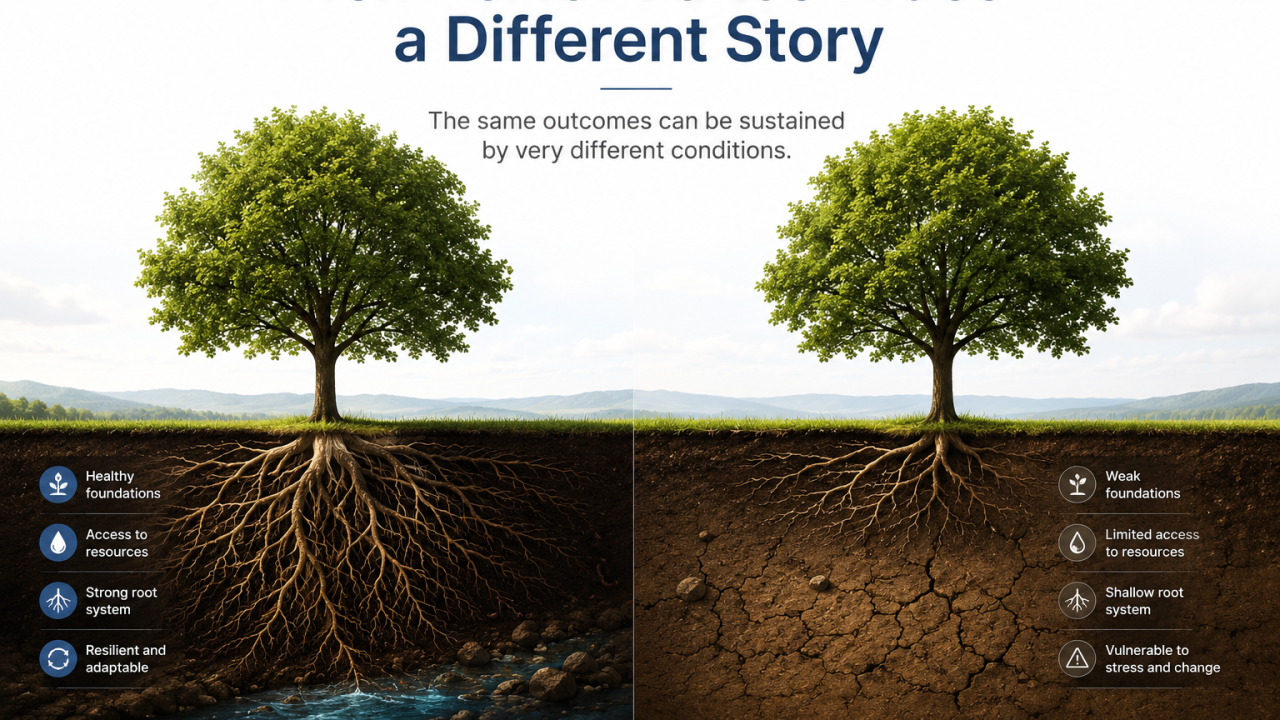
· A team can remain highly engaged while carrying unsustainable workloads.
· A leader can remain committed while gradually exhausting their available capacity.
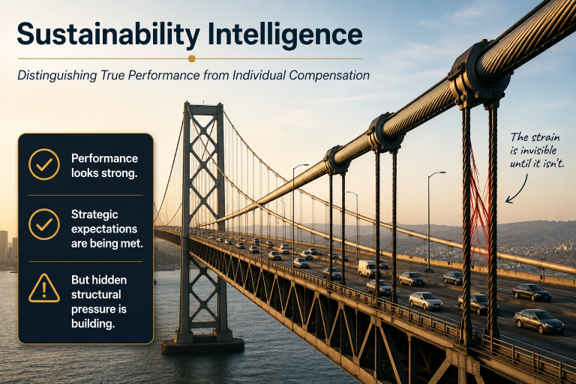
· An organisation can continue performing while adaptability quietly weakens underneath.
· The visible outcome may still appear healthy.
· The underlying conditions may tell a different story.
·
Research into organisational health has consistently highlighted the importance of looking beyond performance metrics alone and examining the organisational conditions that support sustainable performance over time (Keller & Price, 2011).
When Good Metrics Create False Confidence
One of the risks in any measurement system is assuming that what is being measured represents the whole reality.
Sometimes organisations achieve strong engagement scores and conclude:
"We must be doing well."
Perhaps they are.
But perhaps they are also benefiting from:
· highly committed employees
· capable managers compensating for friction
· strong teams absorbing pressure
· leaders carrying additional load
In other words, positive outcomes do not automatically mean healthy underlying conditions.
Just as declining outcomes do not automatically identify the root cause.
This is not a criticism of engagement measurement.
It is a reminder that no single measure can fully explain organisational reality.
The Question Behind the Question
What if one of the most important leadership questions is not:
"How engaged are our people?"
But:
"What organisational conditions are shaping that engagement?"
What if the challenge is not simply measuring commitment, satisfaction, or performance?
What if the challenge is understanding whether the conditions underneath those outcomes remain sustainable enough to support them over time?
The distinction may seem subtle.
I increasingly suspect it is not.
A Different Conversation
Perhaps the future of organisational measurement lies not in choosing among engagement, performance, culture, organisational health, or organisational sustainability.
Perhaps it is learning how to understand the relationships between them.
Because organisations rarely fail from a lack of data.
They often struggle because the conditions shaping that data remain largely invisible.
And that may be one of the most important leadership conversations still waiting to happen.
Reflection
What measures does your organisation rely on most heavily today?
And how much visibility do those measures provide into the conditions producing the outcomes you are seeing?
References
Keller, S., & Price, C. (2011). Beyond Performance: How Great Organizations Build Ultimate Competitive Advantage.
Gallup. (2025). State of the Global Workplace.
Edmondson, A. (2018). The Fearless Organization: Creating Psychological Safety in the Workplace for Learning, Innovation, and Growth.