Helping organisations build the conditions for sustainable performance
Performance Without Sustainability
Why Resilience Alone Cannot Sustain Unsustainable Systems
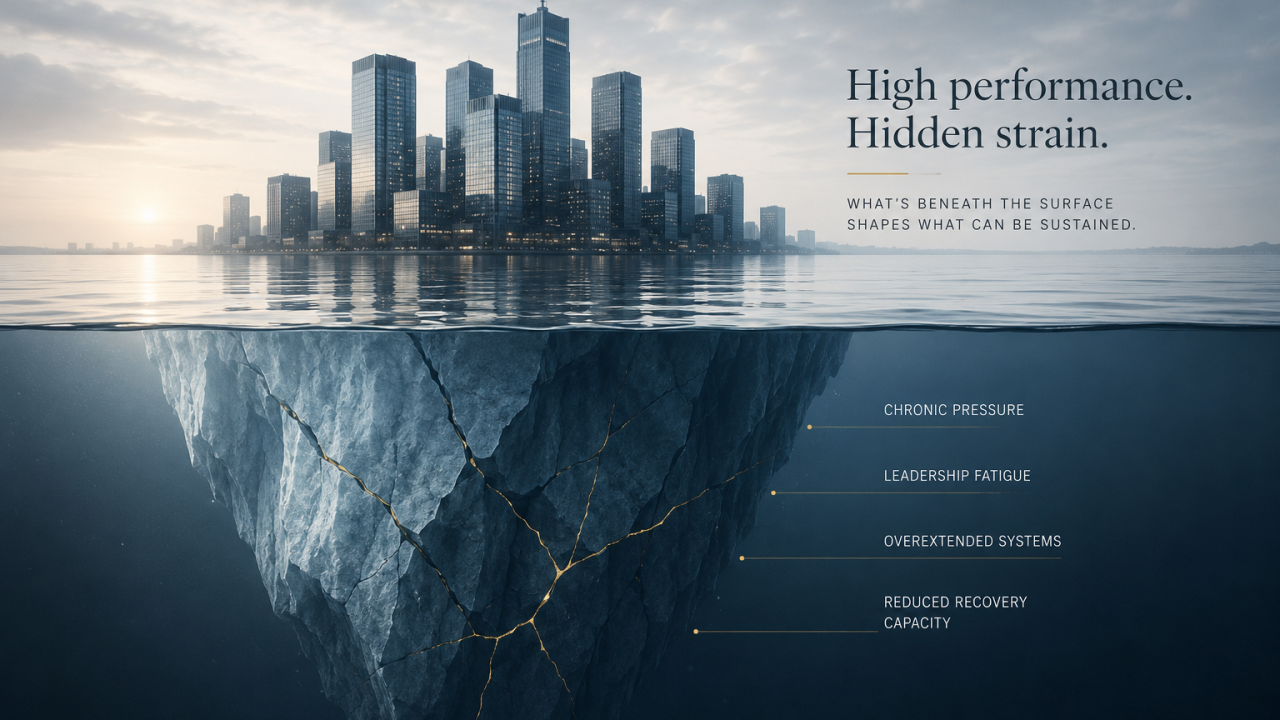
Many organisations continue asking people to become more resilient while failing to examine whether the systems themselves are becoming less sustainable.
Performance targets increase. Transformation accelerates. Complexity grows. Adaptation becomes continuous.
And yet, despite growing conversations around burnout and resilience, many organisations still struggle to ask a deeper question:
Are the conditions underneath performance actually sustainable?
This may become one of the defining leadership questions of the coming decade.
The Resilience Trap
For years, resilience has been framed as an essential professional capability. People are encouraged to become more adaptable, emotionally agile, and mentally strong in increasingly demanding environments.
There is value in resilience. The ability to recover, adapt, and navigate uncertainty matters deeply.
But over the years, I have increasingly started wondering whether some organisations have quietly become structurally dependent on resilience itself.
At some point, asking people to continuously absorb pressure without
examining the systems producing that pressure risks normalising chronic overload.
Resilience should not become a justification for organisational overextension.
The issue is not whether people are resilient enough.
- The issue may be whether modern organisations are creating operating conditions that continuously require resilience simply to remain functional.
From Resilience to System Sustainability
Through the development of the BE-WELL Organisational Sustainability Intelligence Framework, I have increasingly started viewing organisational sustainability through three interacting system conditions:
- stabilising conditions that create resilience, recovery capacity, and agency
- operational consumption conditions that continuously consume human and organisational capacity
- adaptive conditions that determine whether the system can renew, learn, and evolve under pressure
Sustainable performance may emerge less from isolated performance metrics and more from how these conditions remain aligned over time.
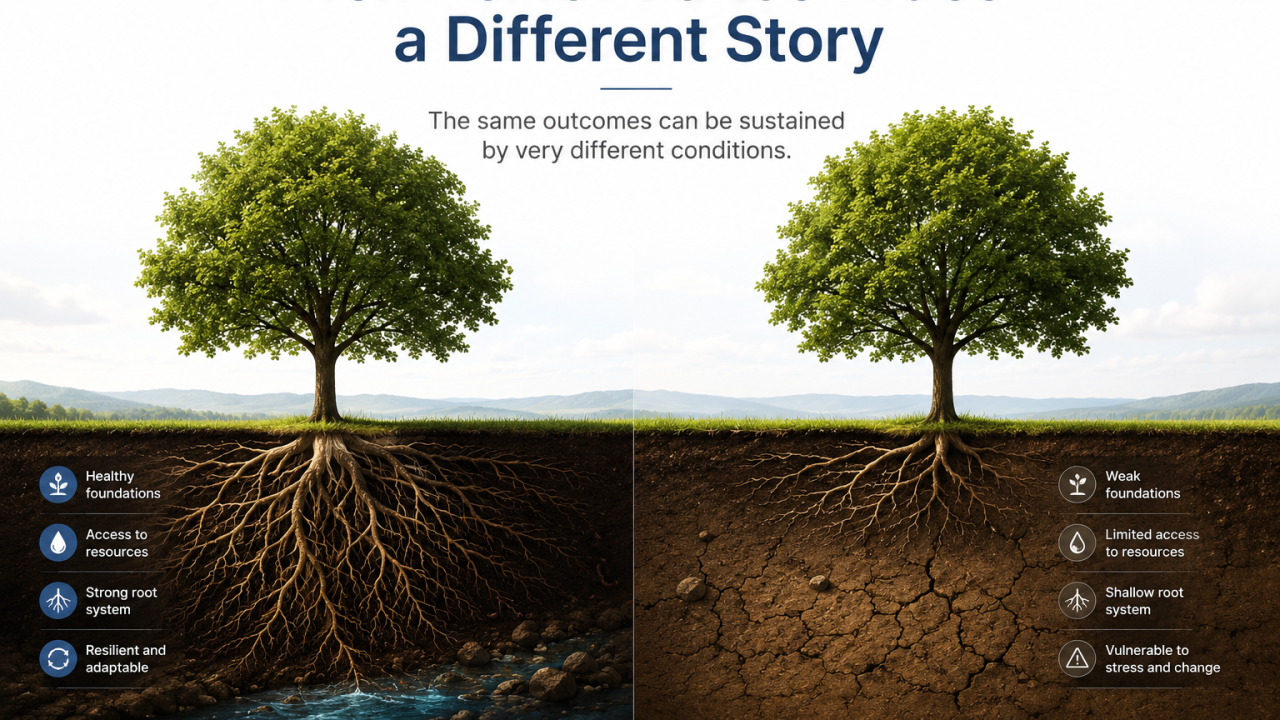
When operational consumption pressure continuously exceeds stabilising and adaptive capacity, organisations may continue performing for some time while quietly accumulating hidden strain beneath the surface.
When High Performance Conceals Instability
One of the challenges modern organisations face is that performance and sustainability are not automatically the same thing.
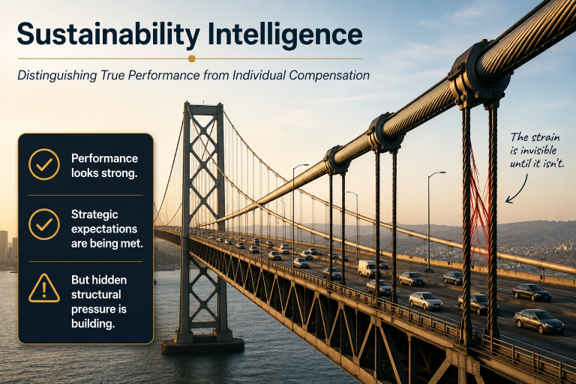
A company can:
- hit targets
- maintain delivery
- sustain engagement
- continue growing
- appear operationally stable
while quietly degrading the conditions required to sustain that performance long term.
In many organisations, pressure does not arrive dramatically.
It accumulates gradually through:
- leadership fatigue
- emotional suppression
- cognitive overload
- reduced recovery capacity
- chronic urgency
- continuous adaptation
- invisible operational friction
Because capable people often compensate for failing systems longer than they should.
I have seen environments where highly committed employees absorb structural overload for years while leadership teams continue believing the organisation is functioning normally because the metrics still look acceptable.
But stable performance does not always mean healthy conditions.
Sometimes it simply means people are compensating silently.
Gallup’s recent workplace research continues to show persistently high stress levels across global workplaces despite growing investments in engagement and well-being initiatives (Gallup, 2026).
By the time visible symptoms emerge, burnout, disengagement, turnover, operational friction, or leadership exhaustion, the underlying strain may already have been building for months or years.
Organisations can therefore appear operationally healthy while quietly accumulating what could be described as sustainability debt.
This may become particularly visible inside fast-growing and continuously transforming environments where operational complexity evolves faster than the organisational conditions required to sustain it.
Why Individual Support Alone Is Not Enough
Research from the Center for Healthy Minds suggests that sustainability is not a fixed trait but a set of trainable skills linked to awareness, connection, insight, and purpose (Center for Healthy Minds, 2024).
Supportive organisational practices therefore matter.
Mindfulness, emotional regulation, psychological safety, and healthier habits can all strengthen individual resilience and improve organisational culture.
But individual support initiatives alone cannot indefinitely compensate for:
- unrealistic workloads
- fragmented leadership systems
- continuous operational acceleration
- environments where recovery is consistently sacrificed for output
- cultures where responsiveness quietly becomes permanent accessibility
This is where many organisations unintentionally drift into what could be described as performative well-being: speaking about care while structurally reinforcing unsustainable operating conditions.
Over the years, I have become increasingly uncomfortable with leadership cultures that genuinely speak about people while simultaneously normalising exhaustion as part of high performance.
Sustainable performance requires more than individual coping strategies.
It requires sustainable systems.
Recovery Is Not the Opposite of Performance
One of the most misunderstood organisational dynamics is the relationship between recovery and performance.
Recovery is often perceived as:
- slowing down
- reduced ambition
- stepping away from performance
But the more I observe leaders and organisations under sustained pressure, the more I believe recovery may actually be one of the conditions that makes sustainable performance possible.
Without recovery:
- clarity declines
- adaptability narrows
- emotional regulation weakens
- decision quality deteriorates
- relationships become transactional
- operational patience disappears
People continue functioning.
But they often stop functioning well.
- In increasingly complex environments, recovery capacity may become less of a leadership luxury and more of a strategic organisational capability.
Leadership Sustainability Is Becoming a Strategic Risk
Recent Harvard Business Review discussions increasingly highlight the emotional and cognitive strain associated with modern leadership environments, particularly under conditions of constant complexity, uncertainty, and responsiveness (Harvard Business Review, 2025).
Leadership today often involves:
- continuous decision pressure
- emotional regulation
- competing priorities
- operational fragmentation
- permanent accessibility
- continuous adaptation
And because many leaders continue functioning under pressure, the strain frequently remains invisible until exhaustion, impaired judgement, relational breakdown, or emotional detachment begin to emerge.
I increasingly believe leadership sustainability is becoming one of the least discussed but most important organisational risks of modern operating environments.
Not simply because leaders become exhausted.
But because exhausted leadership teams eventually shape exhausted systems.
From Symptoms to Systems
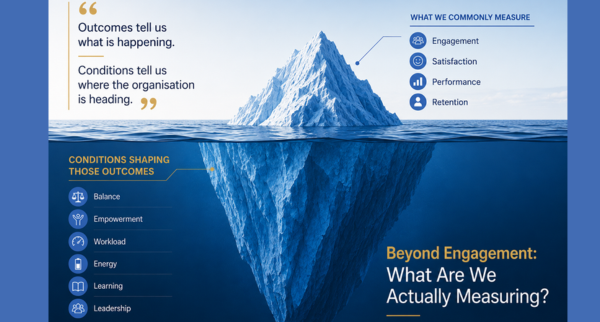
Many organisations still primarily measure:
- productivity
- engagement
- retention
- delivery
- operational performance
These metrics remain useful.
But sustainability may emerge less from isolated metrics themselves and more from the alignment between stabilising capacity, operational consumption pressure, and adaptive capability across the system. This creates an important shift in perspective.
Rather than asking only: “How do we improve performance?”
Leaders may increasingly need to ask: “What conditions are shaping that performance, and are those conditions sustainable over time?”
This is fundamentally a systems question.
Not simply an individual resilience or well-being discussion.
The Emerging Leadership Challenge
The organisations most likely to remain sustainable in the future may not be those capable of generating the highest short-term output.
They may be those most capable of sustaining:
- recovery
- trust
- adaptability
- reflection
- leadership sustainability
- healthy operating conditions
over time.
Because systems that continuously consume human capacity without restoring it eventually begin functioning through depletion.
And depletion, when normalised long enough, becomes organisational fragility.
Closing Reflection
Over the last few years, I have become increasingly interested in the hidden conditions shaping sustainable organisational functioning.
That reflection is part of what led me to begin developing BE-WELL™, not simply as a traditional workplace well-being initiative, but as a systems-oriented exploration of:
- sustainable performance
- leadership sustainability
- organisational conditions
- operational pressure
- recovery capacity
The more I observe modern organisations, the more I believe the future leadership challenge may not simply be generating performance, but understanding how stabilising capacity, operational pressure, and adaptive capability remain sustainably aligned over time without gradually consuming the human systems required to sustain performance. Because organisations rarely break only when performance drops.
Often, they begin breaking long before the metrics visibly move.
References
· Center for Healthy Minds. (2024). Why Well-Being is a Skill. Retrieved from https://centerhealthyminds.org/news/why-well-being-is-a-skill
· Change Mental Health. (2024). Skills Development and Mental Health. Retrieved from https://changemh.org/resources/skills-development-and-mental-health/
· Gallup. (2026). State of the Global Workplace 2026 Report. Retrieved from https://www.gallup.com/workplace/349484/state-of-the-global-workplace.aspx
· Global Wellness Institute. (2024). Well-being Intelligence: The Leadership Competency Organizations Can No Longer Ignore. Retrieved from https://globalwellnessinstitute.org/industry-research/well-being-intelligence-the-leadership-competency-organizations-can-no-longer-ignore/
· Harvard Business Review. (2025). Leading Is Emotionally Draining. Here’s How to Recover.